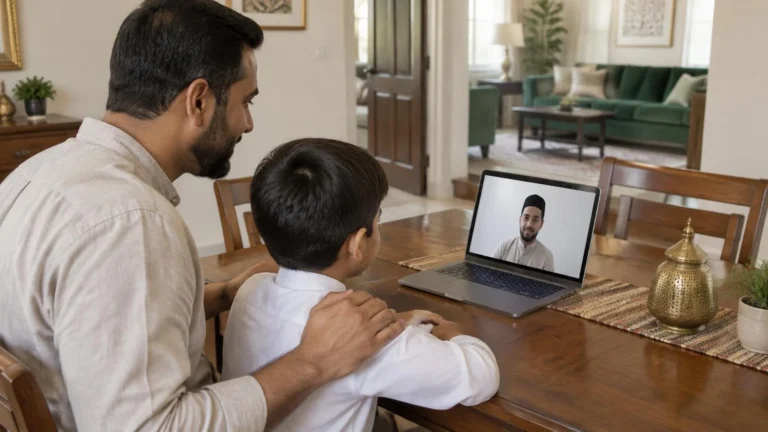


Ten focused minutes a day, at the same time, with you sitting nearby: that is the simplest routine that helps a child make steady progress with the Quran. Lessons teach new material, but home practice is where it sticks. You do not need to be a Quran teacher to make it work. This guide gives you a routine, what to listen for, and how to keep it positive.
Why home practice matters so much
Children forget quickly when a lesson is not reviewed. A child who revises for ten minutes on the days between lessons arrives ready for the next step; a child who does not often spends half the next lesson relearning the last one.
The Prophet ﷺ said that the most beloved deed to Allah is the most regular and constant even if it were little
(Sahih al-Bukhari 6464). A short daily habit is exactly that.
The 10-minute daily routine
| Minutes | What to do |
|---|---|
| 1 | Settle: wudu if possible, sit at the same table, open the Qaida or Mushaf respectfully |
| 2 to 6 | Your child reads the last page from their lesson aloud, pointing at each letter |
| 7 to 9 | Repeat any line that was shaky, slowly, two or three times |
| 10 | Finish with something they can read well, and a word of praise |
Ending on success matters. Children remember how practice felt more than what they practised.
Pick a fixed time
Attach practice to something that already happens every day, so nobody has to remember it:
- straight after Fajr or Maghrib;
- after school, before screens;
- before bed, as part of the bedtime routine.
Keep it at the same table in a shared room. A consistent place signals that it is time to focus.
What to listen for (even if you are still learning yourself)
- Is your child reading or reciting from memory? Point to a word out of order. If they cannot read it, slow the pace.
- Are long vowels long and short vowels short? Length changes meaning in Arabic.
- Are similar letters different? Listen for ح versus ه, and ع versus ء.
- Which lines were difficult? Note them and mention them to the teacher.
If you are not sure how a word should sound, do not guess and correct. Play the passage from a clear reciter and let your child repeat after it, or ask their teacher. Correct pronunciation is the teacher’s job; consistency is yours.
Keep it positive
- Praise effort, not just results. “You kept going on that hard line” builds persistence.
- Correct gently and briefly. Model the sound once, let them try again, move on.
- Never use the Quran as a punishment. Practice should never feel like a consequence for misbehaving.
- Stop before frustration. Ten good minutes beat twenty tearful ones.
- Celebrate milestones, such as finishing a Qaida stage or a first surah, with something your child looks forward to.
Let them see you learning too
Children copy what they see. Reading the Quran yourself, even a few lines, or listening to recitation at home, tells your child it matters to the whole family. The Prophet ﷺ said, The best among you are those who learn the Qur’an and teach it
(Sahih al-Bukhari 5027). Learning alongside your child is part of that.
Practice by age
| Age | Practice length | Your role |
|---|---|---|
| 4 to 6 | 5 to 10 minutes | Sit beside them, point together, keep it playful |
| 7 to 10 | 10 to 15 minutes | Stay nearby, listen to the last page, note tricky lines |
| 11 and over | 15 to 20 minutes | Check in, ask them to recite a new portion to you once a week |
Work as a team with the teacher
The best progress happens when parents and teacher share notes. After each lesson, find out what was covered and what to practise; before the next one, mention anything your child struggled with. Our lessons include short progress notes for parents for exactly this reason, and all communication goes through you, never directly to your child. If you are still choosing a teacher, our parent’s checklist will help, and you can see how we teach on our Quran classes for kids page.
Frequently asked questions
How long should my child practise the Quran each day?
About 5 to 10 minutes for young children and 10 to 20 minutes for older ones. Regular short sessions work better than long, occasional ones.
I can’t read the Quran well myself. Can I still help?
Yes. Your job is to create the routine, sit nearby and encourage. Use recitation audio to check sounds, and leave detailed correction to the teacher.
My child refuses to practise. What should I do?
Shorten the session, make the time predictable, and end on something they can do well. If resistance continues, talk to the teacher. A change of pace or approach often helps.
Should my child practise on days without a lesson?
Yes. The days between lessons are when practice matters most, because that is when forgetting happens.