

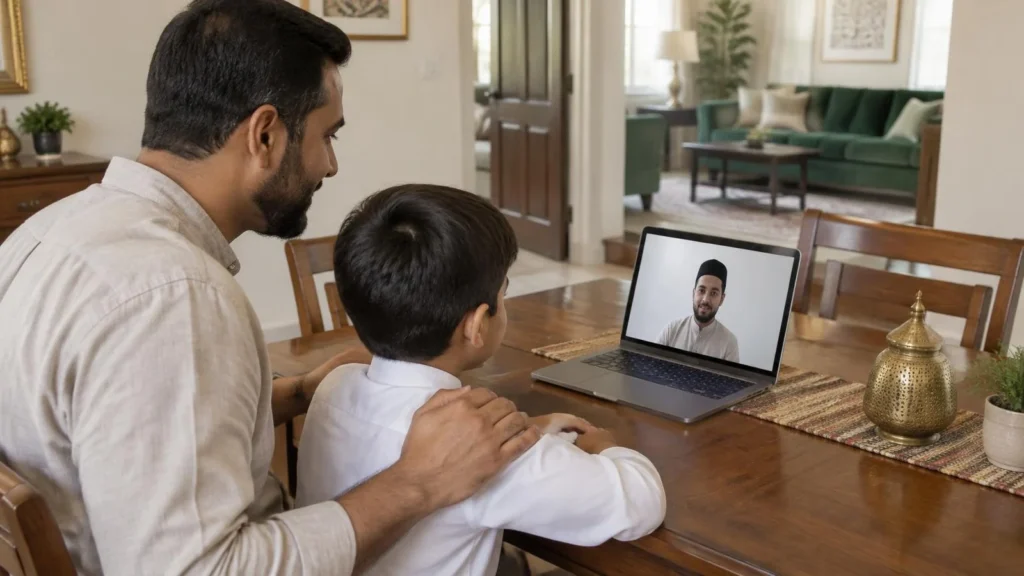
The best online Quran classes for kids are live and one-on-one, with the same qualified teacher every week, short lessons sized for your child’s age, clear progress updates for you, and sensible safety rules. This checklist explains what to look for, which red flags to avoid, and the questions to ask before you book.
The quick checklist
- One teacher, every lesson, not a rota of tutors.
- Qualifications you can see, and experience teaching children.
- Live, one-on-one lessons where the teacher hears every sound your child makes.
- Lesson length that fits your child’s age, with a clear structure.
- Safety rules: you are always welcome, and the teacher contacts you, not your child.
- A clear syllabus and regular progress notes.
- A free trial lesson you can watch, with no payment details needed.
- Simple, monthly pricing with no long contract.
1. One teacher, not a rota
Children learn best from an adult they know and trust. A teacher who sees your child every week remembers which letters were difficult, notices when attention drops, and knows how to encourage them. Large academies sometimes rotate tutors or change them at short notice, which means starting over again and again.
Ask: “Will my child have the same teacher every lesson? What happens if they are unavailable?”
2. Qualifications and experience with children
Reading the Quran well and teaching it to a six-year-old are different skills. Look for both: a sound knowledge of Quran reading and Tajweed, and real experience teaching young learners.
- Can you see the teacher’s certificates or qualifications?
- How long have they been teaching, and how many students have they taught?
- Do they teach children regularly, or mainly adults?
The Prophet ﷺ said, The best among you are those who learn the Qur’an and teach it
(Sahih al-Bukhari 5027). A good teacher carries that responsibility with patience and care.
3. Live and one-on-one
Children learn pronunciation by listening, imitating and being corrected straight away. In a group class or a recorded course, your child recites for only a few minutes, and mistakes often go unnoticed. In a one-on-one lesson, they recite for most of the lesson and every sound is checked.
4. Lesson length and structure that fit your child’s age
Short, frequent lessons work better than long, occasional ones, especially for young children. As a practical starting point:
| Age | Lesson length | Lessons per week | Parent’s role |
|---|---|---|---|
| 4 to 6 | 20 to 30 minutes | 2 to 3 | Sitting beside the child |
| 7 to 10 | 30 minutes | 3 to 5 | Nearby and within earshot |
| 11 and over | 30 to 45 minutes | 3 to 5 | Checking in and reading progress notes |
Every child is different. A good teacher will adjust the length and pace after the first few lessons, and tell you honestly if your child would do better starting a little later.
Inside the lesson, look for a predictable rhythm: a quick review, something new, guided reading and a short recap. Structure helps children settle and makes progress visible.
5. Safety rules you are comfortable with
Online lessons happen at home, which makes it easy to put good safeguards in place. The NSPCC, the UK’s leading children’s charity, advises parents choosing a tutor to:
- ask for checks and references: criminal record checks and full reference checks
as a minimum
; - agree in advance how you will communicate, and make sure the tutor
always contacts you and never has direct contact with your child outside a session
; - make sure
you or another adult are within earshot
, and feel free to sit in; - choose a quiet table in a shared space rather than a bedroom, with the door open;
- ask for regular updates on progress and talk to your child about how it is going.
Any academy you choose should welcome these rules, not resist them.
Ask: “Can I sit in on lessons? Who will contact my child, and how?”
6. A clear syllabus and regular progress notes
You should always know what your child is learning, what to practise at home and what comes next. A typical pathway for children is:
- Noorani Qaida: the letters, their sounds and vowel marks.
- Reading from the Mushaf: building fluency line by line.
- Basic Tajweed: ghunnah, qalqalah, madd and the rules of noon sakinah.
- Short surahs and memorization: usually starting with Juz ʿAmma.
Short written notes after lessons are more useful than a long report once a term. They tell you exactly what to practise for five or ten minutes a day.
7. Correct pronunciation from the first lesson
Some programmes rush children through the alphabet to reach the Quran faster. It feels like progress, but letters learned from the wrong place in the mouth take months to correct later. Look for a teacher who insists on correct sounds (makharij) from the start, kindly and patiently.
8. A free trial you can judge for yourself
A trial lesson should be a real lesson, not a sales call. Watch it with your child and notice:
- Did the teacher learn your child’s name and talk to them, not just at them?
- Were mistakes corrected gently and clearly?
- Did your child speak and recite for most of the lesson?
- Did you get honest feedback on your child’s level and a clear plan?
- Did your child want to come back?
9. Clear, flexible pricing
Look for a simple monthly price per child, a clear number of lessons, and the freedom to pause or stop without a long contract. Ask how rescheduling works if your child is ill or travelling.
Red flags
- A different teacher every week, or a teacher you never get to meet before paying.
- No way to see the teacher’s qualifications.
- Pressure to pay for several months up front.
- Discouraging parents from sitting in, or wanting to message your child directly.
- No syllabus, and no updates on progress.
- Lessons that are mostly the teacher talking while your child listens.
Questions to ask before you book
- Who exactly will teach my child, and will it always be the same person?
- What qualifications and experience with children does the teacher have?
- How long are lessons, and how is each lesson structured?
- Can I sit in? How will the teacher contact us?
- How will I know what my child has learned and what to practise?
- What does it cost per month, and how do pausing and cancelling work?
Frequently asked questions
Are online Quran classes good for kids?
Yes, when they are live, one-on-one and well structured. Children can recite for most of the lesson, parents can easily sit in, and there is no travel. Very young children do best with a parent beside them.
What age should a child start learning the Quran?
Many children begin structured lessons at around four or five, as long as they can focus for a short lesson with a parent nearby. A trial lesson is the easiest way to judge readiness.
How often should my child have Quran lessons?
Three short lessons a week suits most children, with five to ten minutes of practice on the other days. Regular practice matters more than long sessions.